You will find below:
-Customs information for non-European participants
-Address where the intruments should be shipped to Crete
-Transport to Hania and accomodation in Crete during the campaign
-PAUR II List of people that will be present during the Cretan Campaign (please check for your name!)
-PAUR II Sum of Power Requirements (please check for your instruments!)
-Answers to Frequently Asked Questions (FAQ's). Any new questions? You can post your questions regarding the Campaign: Just click general or technical, depending on the nature of your question.
-A database on material (data, maps...) relevant to PAUR II. Do you have relevant material to submit?
Customs clearance for participants
Non EU participants should arrange for CARNET ATA and consult with their customs. The carnet ATA is necessary for passing through customs the instrumentation brought to Crete. If you bring the intrumentation with you, you should carry the CARNET ATA with you. If you ship the instruments, the CARNET ATA should accompany the instruments. The best way might be to ship the instruments to the address given below, and arrange with the shipping company to pass the instruments through customs and deliver them to the Orthodox Academy of Crete.
European Union participants do not have to make any arrangements for customs.
Address where the intruments should be shipped to Crete
Please ship instrumentation that will be deployed in Crete to:
Orthodox Academy of Crete
GR-73006 Kolymbari-Chania
GREECE
tel.: +30-824-22245, 22500
fax: +30-824-22060
Transport to Hania and accomodation in Crete during the campaign
Accommodation for all participants of PAUR II campaign will take place in the Orthodox Academy of Crete
(OAC), in Kolimbari, which is situated approximately 25 km west of Chania. LAP will arrange for the accomodation of those that wish to stay at OAC. Air temperatures in Chania in May range between 15oC - 24oC and relative humidity is about 64%.The best way to reach the Hotel is by taxi, which will take you there from the airport in about 45 minutes and for a fee of approximately 7.000 Drs. The phone number of the Academy is +30 824 22245 and the fax is +30 824 22060.
Chania (Crete) can be reached by boat (12 hours from Piraeus – Athens), by air (1 hour from Athens airport) or from European cities with charter flights. Please refer to http://www.areianet.gr/infoxenios/english/crete/hania/transport.html#byair for further tourist information, rental of cars etc.
PAUR II List of people that will be present during the Cretan Campaign (Update 9.2.99)
Only those indicated with
bold letters have confirmed, the rest is our guess...| No. of people | Names (arrival-departure) | Institute |
4 |
Zerefos/ Kourtidis/ Tzortziou, Gazerian (2-29.5) | LAP |
2 |
Bais (2-8.5, 19-26.5) / Balis (15-28.5) | LAP |
1 |
Kazatzis (2-8.5) | LAP |
2 |
Rapsomanikis/+1 Ph.D. (2.-28.5) | DUTH |
2 |
Stefanou/? | ECPL-UC |
1 |
Melas (3-10.5) | DESUA |
1 |
Papayannis | NTUA |
3 |
Fabian/Rappenglueck/Hofman (2-29.5) | UMUN |
2 |
Isaksen / | UiOSLO |
2 |
Pommereau /Antivillo | CNRS |
1 |
Schmitt (2-29.5) | MetCon |
3 |
Gobbi/Conidi/Giorgi () | IFA/CNR |
2 |
Blumthaler (1-20.5) | UInns |
4 |
Calpini/Quaglia/Simeonov/Lazarotto () | EPFL |
7 |
2*Herman (30.4-10.5) /2*Labow (30.4-10.5 + 21-28.5) /Ward, Thompson, Witte (30.4-10.5) | GSFC |
2-3 |
Gillotay / (2.-29.5) | IASB |
2 |
Cornwall / () | NOAA |
2 |
Clemitshaw / () | ICCET |
TOTAL 42 |
PAUR II Sum of Power Requirements (Update 9.2.99)
Prases Village - HIGH ALTITUDE
Parameter |
Consumption / Amp |
Partner |
O3 column, spectral radiation |
LAP |
|
UVery radiation |
LAP |
|
Radiation |
LAP |
|
Meteorological |
LAP/UMUN |
|
DOAS measurements |
CNRS |
|
O3, NO2 column |
CNRS |
|
Black carbon |
0.2 kW |
DUTH |
Particles |
1.6 kW 4 A |
DUTH |
Impactor Aerosols |
0.2 kW |
UC |
O3 |
0.1 kW 12A |
UMUN |
NOx |
0.35 kW 12 A |
UMUN |
PAN |
0.13 kW 12 A |
UMUN |
HCs |
3,5 kW 16 A |
UMUN |
Small parts |
2,5 kW 12 A |
UMUN |
HO2 + RO2 |
ICCET |
|
Total O3 |
NASA/GSFC |
|
Radiation |
NASA/GSFC |
|
UV Radiation |
NASA/GSFC |
|
J-O3, J-NO2 |
0.4 kW |
METCON |
TEMPORARY SUM 8.9 kW
Kolimbari - LOW ALTITUDE
Parameter |
Instrument/technique |
Partner |
|
DOAS measurements |
CNRS |
||
Scattering coefficient |
0.2 kW |
DUTH |
|
Aerosol opt. Depth |
0.44 kW 2 A |
DUTH |
|
Particle size analyser |
0.44 kW 2 A |
DUTH |
|
Particles |
1.6 kW 4 A |
DUTH |
|
| Total Organic Carbon | DUTH/UC | ||
O3 |
0.1 kW 12A |
UMUN |
|
NOx |
0.35 kW 12 A |
UMUN |
|
PAN |
0.13 kW 12 A |
UMUN |
|
HCs |
0.3 kW 12 A |
UMUN |
|
Small parts |
0.36 kW 12 A |
UMUN |
|
J-O3, J-NO2 |
0.4 kW |
METCON |
|
Meteorological |
0 (Solar) |
DUTH/LAP |
|
DIAL Aerosol and ozone vertical distr. 50m-5 km |
23 kW 3 phases 20A/phase |
EPFL |
|
LIDAR Aerosol |
4 kW 20 A |
IFA/CNR |
|
Total O3 |
NASA/GSFC |
||
Ozonesondes |
NASA/GSFC |
||
Aerosol vertical profile |
3 kW (MicroPulse) [+ 6 kW if other LIDAR is brought] |
NASA/GSFC |
|
Aerosol optical depth (CIMEL Sun photometer) |
NASA/GSFC |
||
Aerosol composition (Filter Aerosol Collection) |
NOAA /SRRB |
||
| RADIOMETRIC MEASUREMENTS | SUM < 4kW | ||
O3 column, spectral radiation |
IASB Univ.Innsbruck |
||
UV-ery radiation |
IASB |
||
Radiation |
IASB |
||
Radiation |
NASA/GSFC |
||
UV Radiation |
NASA/GSFC |
||
Spectral radiation |
NOAA/ SRRB |
||
UV-ery |
NOAA /SRRB |
||
Total Irradiance |
NOAA /SRRB |
||
TEMPORARY SUM 34.5 kW (of which 23 kW EPFL LIDAR, Radiation measurements, SUM < 4kW excluded)
Cruising vessel
| Parameter | Consumption / A | Partner |
| O3 | 100 W | UMUN |
| Laptop | 30 W | UMUN |
| GPS | ? | |
| UVery | IASB |
TEMPORARY SUM 130 W
Answers to FAQ's
Exact dates of the campaign: 3-28.5.99
Setup/intercalibrations: 3-5.5.99
Instrumentation take down: 28-29.5.99
Distance computer room/instrumentation: 25 m at most.
Transportation from Prasses to Kolimbari: Car rental. Please refer to http://www.areianet.gr/infoxenios/english/crete/hania/transport.html#byair for car rental information.
Some photographs of the sites are posted in this web site.
LAP will arrange:
Provision of gas cylinders on sites at the expenses of the consumers
Provision of Ethanol on site
Provision of water steel tubing (1 1/4 '' or 42 mm) 4*2,5 m + 1*1,5 m at each site (METCON) at the expenses of the METCON.
Ozonesonde chemicals (GSFC, Ann Thompson should specify needs)
Water supply at both sites
Computer room at Kolimbari site, where data aquisition instrumentation and PCs of the participants can be sheltered.
Laptop (386) for downloading data from dataloggers (up to 20 MB)
Computer room with printer/internet access at OAC
Refrigerator at Prasses/Kolimbari for ICCET/UMUN chemicals
LAP will NOT arrange:
Voltage converters (115 a 220 V): They should be brought by the groups whose instruments require 115 V.
Transportation of equipment from airport to sites: Please ship directly to OAC.
LAP is currently checking the following requests:
Arrangements for dark calibration room + 1000 W calibration lamp (METCON, IASB) at Kolimbari
CO measurements: We are not very optimistic about that...
Accomodation possibilities for 2 (ICCET) + 3 (CNR) persons at Prasses
The Lambedusa site
At present, the following instrumentation has been installed and is operational:
- Brewer MK IV # 123 (ozone calibration performed in May 1998, UV calibration performed in
April 1999), ENEA
- Yankee Multi Filter Rotating Shadowband Radiometer, NOAA
- Solar Light UVA radiometer, NOAA
- Solar Light UVB radiometer, NOAA
- Yankee UVB-1 radiometer, NOAA
- Biospherical GUV-511 radiometer, NOAA
- Eppley Precision Spectral Pyranometer, NOAA
- Eppley Black and white pyranometer, ENEA
- Kipp and Zonen pyranometer, ENEA
- meteorological station, ENEA
- CO2 analyzer, ENEA
On May 3, the following instruments will be also installed at Lampedusa:
- Backscatter/depolarization lidar (532 nm), University of Rome "La Sapienza"
- Aureole sensor POM-01L, CNR
The concentration of methane, N2O, CFC-11 and CFC-12 is also determined weekly by ENEA
from collected gas samples.
The participation of an ultralight aircraft from the Fraunhofer Institut Atmosphaerische
Umweltforschung,
equipped with an optical particle counter (FSSP-300), a condensation nuclei counter, an
ozone photometer, a
global radiation pyranometer, and upward and downward looking UV-B radiometers is still
uncertain, depending
on the approval of the flight authorizations.
Continuous observations will be collected from the first week of May to June 20.
Database on material relevant to PAUR II
Location of the two measuring sites in Crete
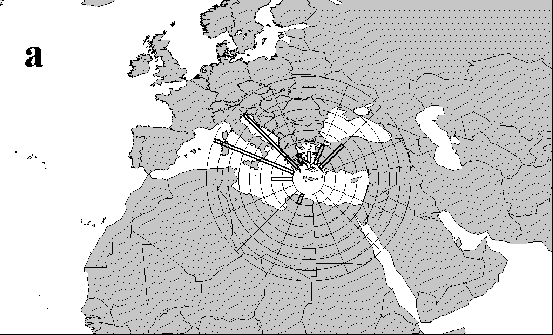
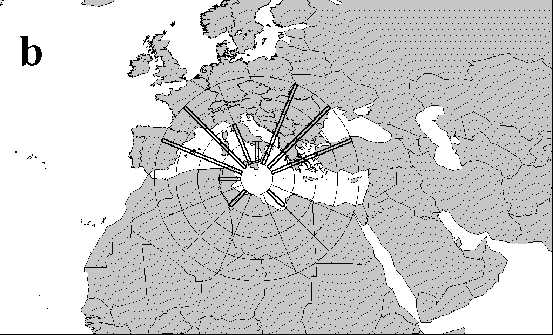
Meteorology: Directional frequencies of 96-hous trajectories arriving at Creta (a) and Lampedousa (b) during May 1997 (1000 hPa). The bars indicate the number of days when the air masses arriving at the two sites were originating from the respective direction. The trajectories were calculated using the Hybrid Single-Particle Langrangian Integrated Trajectory Model (HYSPLIT) developed at NOOA ARL (from D. Melas, DESUA).
Satellite image and weather forecast for the next 24, 48, 72, 96 or 120 hours (surface temperature, wind, rainfall, relative humidity, isobars) for East Mediterranean at http://www.forthnet.gr/weather/
Examples of satellite images of dust storms affecting Eastern Mediterranean (from the Operational Significant Event Imagery site of NOAA): 15 Mar 1998 and 16 Mar 1998. If a significant dust event occurs during PAUR II, we might be able to see the satellite picture of it at http://www.osei.noaa.gov .

